

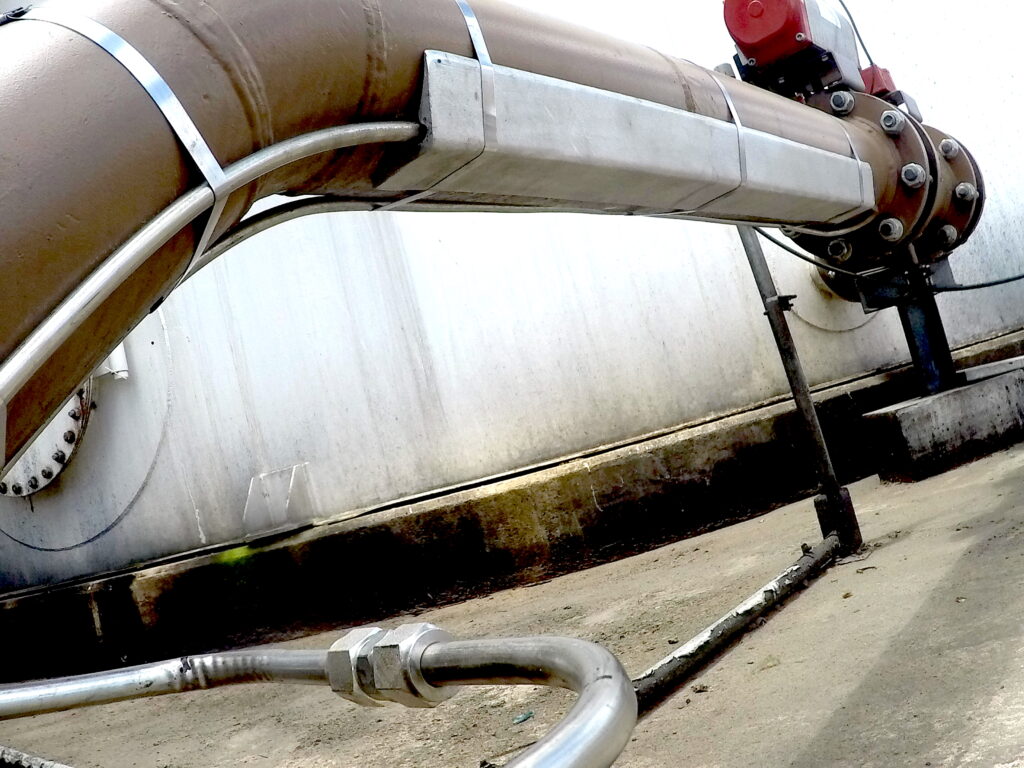
Assessment errors are cheap to correct on paper and expensive to correct in the field.. Em steam trace, The most frequent problems do not arise during installation: are born before, when raising the application. These are the five mistakes that most appear at this stage and what to do to avoid them.
Steam tracing maintains the temperature of lines and equipment using steam as a heat source. The principle is simple, but the correct solution depends on a complete reading of the application: the product, the temperature, the piping, the plant environment and infrastructure. When this reading fails, the system even works, but below what it should be, consuming more, requiring more maintenance or leaving the line vulnerable exactly when it needs heat most.
The good news is that evaluation errors repeat themselves, and therefore they are predictable. These are the five most common.
ERROR 1
Consider only the length of the pipe
Line length is essential data, but it's not the only one. Valves, flanges, instruments, bombs, curves and points drainage are part of the route and need to be included in the survey. When the assessment only considers linear meters, the result is an incomplete portrait of the application, and the scaled solution for this portrait does not match the actual line.
How to avoid: raise the complete pipeline route, recording all accessories and critical points, with drawing support, isometrics and photos whenever available.
ERROR 2
Ignore thermal insulation
Unintended, the steam dash loses a lot of efficiency: the solution may be more expensive, consume more vapor and present unsatisfactory performance. Even so, It is common for the assessment to skip this check, assuming that the existing insulation is adequate, or simply forgetting that it doesn't exist.
How to avoid: check if the line is insulated, what kind, how thick, under what conditions and with what external protection. Damaged or missing insulation changes the solution, and it is better to discover this in analysis than in operation.
ERROR 3
Not checking the actual available steam pressure
The steam trace solution is designed from the plant infrastructure: nearby steam network, available pressure, type of steam and feeding points. Assuming a nominal value without confirming the actual system pressure compromises the analysis from the source, because the entire design of the solution starts from this data.
How to avoid: confirm with operations or utilities the actual pressure available at the supply point, and also record whether the steam is saturated or superheated.
ERROR 4
Forgetting that condensate needs to be drained
When steam delivers heat, it condenses. This is how the system works, and that's why every steam trace generates condensate, which needs to be drained correctly through purgers e, when possible, returned to the system. Assessments that only look at the steam inlet and ignore the condensate outlet leave half the circuit out.
How to avoid: map drainage points from analysis, the need for traps and the possibility of condensate return, treating the circuit as a whole.
ERROR 5
Assume that every steam trace application is the same
This is the error that sums up the other four. Each application depends on the product, of the temperature, of the line, the environment and plant infrastructure. Two lines with the same product may need different solutions just because they are in different environments. And then there is the most important distinction of all: Maintaining the temperature of a line is one thing; heating a product in a defined time is another, which requires more detailed thermal analysis.
How to avoid: treat each application as a new case, starting with understanding the product and the objective, and not for the ready-made solution.
In summary: you 5 errors
What cannot be missed in the evaluation
- Every error avoided in the analysis is one less problem in the operation.
- 1. Consider only the length and forget about valves, flanges, instruments and drain points;
- 2. Ignore the line thermal insulation;
- 3. Not checking the actual available steam pressure;
- 4. Forget about draining and returning condensate;
- 5. Assume that every steam trace application is the same.
The right assessment from the start
Na tayga, the analysis of a steam trace application follows a structured script, passing through the product, by temperature, through the pipe, by isolation, the environment and the plant's steam and condensate infrastructure.
It is this method that prevents the five errors above from reaching the proposal, and ensures that the solution presented corresponds to the reality of the operation.
Have an application in mind? Talk to us.