

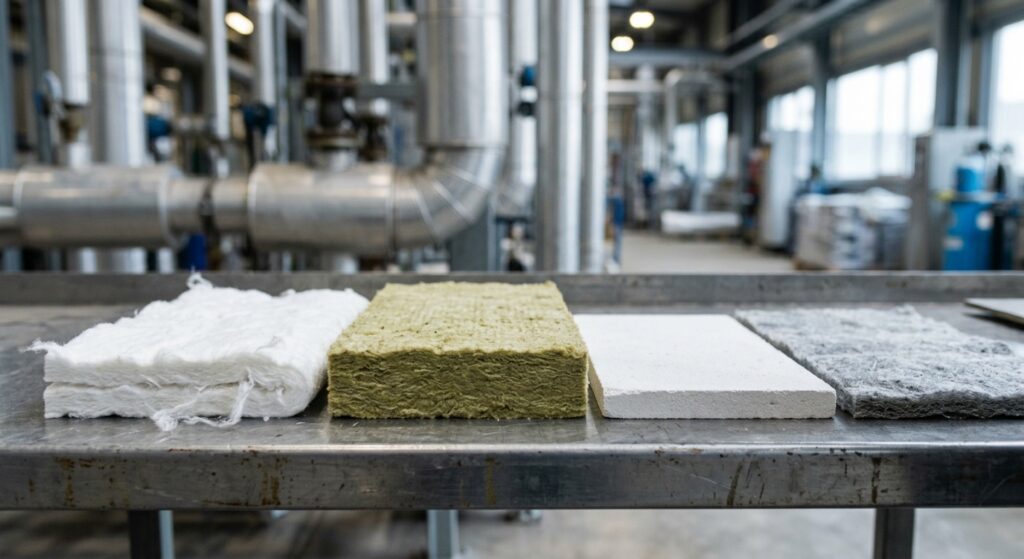
Four materials, four different proposals. One is designed for high temperatures, another is known for good value for money, the third supports mechanical stress and the fourth delivers high performance in reduced thicknesses. Choosing the wrong material means paying more or losing efficiency. This guide presents each of them and shows what weighs in the decision..
When a project thermal insulation reaches the specification stage, three definitions are at stake: the insulating material, thickness and external finish. Of this trio, the material is a choice that directly depends on the application, because each option was developed for a type of challenge. Operating temperature, environment, available space, mechanical effort and budget pull the decision in different directions.
In Tayga's analysis, four materials appear most frequently: ceramic fiber, lã de rocha, calcium silicate and airgel. Let's get to know each one, its main applications and what requires attention.
Lã de rocha: the common market solution
Rock wool is produced from basalt rocks melted at very high temperatures and transformed into fibers, which are then gathered into blankets, panels, tubes and flakes. It is one of the most common solutions on the industrial insulation market, and for good reasons: good delivery thermal performance good value for money, It is non-combustible and also adds acoustic and thermal insulation.
Main applications: general industrial applications, like pipes, tanks, boilers and equipment operating at temperatures that, depending on the manufacturer and product line, arrive at the house 750 °C in continuous mode. The variety of formats facilitates application in different geometries.
Points of attention: like all fibrous insulation, Rock wool loses performance when soaked. In external environments or subject to washing, the external finish and the tightness of the set are part of the solution, They are not accessories.
Ceramic fiber: for high temperatures and severe applications
Ceramic fiber is produced from the fusion of high purity alumina and silica, generating fibers that withstand thermal conditions far above those of mineral wool. Typical commercial lines have a temperature class of 1.260 °C, with working temperature in the house 1.100 a 1.150 °C, according to the manufacturer.
Main applications: It is the stuff of severe applications: ovens, boilers, greenhouses, hot gas ducts and refractory support insulation. It's light, has low thermal conductivity, Low heat storage and inert to thermal shock, that is, withstands sudden changes in temperature without degrading.
Points of attention: It is a material designed for high temperatures. Suitability for each application is assessed by engineering, considering the actual thermal requirement of the process.
Calcium silicate: mechanical and thermal resistance
Calcium silicate is a rigid insulator, molded into plates, gutters and segments, with a characteristic that differentiates it from previous ones: high mechanical resistance. It is the material specified when the insulation will undergo physical stress, as surface traffic from operators, ladders supported on the piping or light impacts from day-to-day plant life.
Main applications: piping and equipment subject to mechanical stress, large diameter pipes, tanks and flat surfaces, at temperatures that, according to the product line, go from 650 °C a 815 °C. It is asbestos-free, non-combustible and chemically inert, which makes it a constant presence in refineries, petrochemical and thermoelectric plants.
Points of attention: as it is a rigid insulator, its typical applications are flat surfaces, cylindrical pipes and equipment. As with other materials, performance depends on correct installation and suitable finish.
Aerogel: maximum performance in minimum space
Airgel is the most recent among the four and, according to manufacturer data, the one with the lowest thermal conductivity among them. Produced from nanoporous silica combined with reinforcing fibers, has extremely low thermal conductivity, at the house of 0,018 W/m·K at room temperature, according to manufacturer data.
Main applications: where there is a lack of space and a surplus of demand. Manufacturers indicate that the airgel blanket allows the insulation thickness to be reduced to a fraction of that required by conventional materials, which makes it the natural choice for congested areas, flanges, elbows, complex equipment and projects where every centimeter counts. It is hydrophobic, flexible and has a strong presence in the oil and gas sectors, petrochemical and offshore.
Points of attention: the cost is higher than that of traditional materials. Its specification is usually justified when the available space or the performance requirements of the application require, and this assessment is made case by case by engineering.
And the external finish?
None of these materials work alone. Outside the insulation comes the external finish, moisture protection, impact and bad weather, and its choice follows the application environment: aluminum sheet for general applications and less aggressive environments; stainless steel plate 304 for humid environments or with greater need for corrosion resistance; and stainless steel plate 316 for the most aggressive environments, such as offshore areas, marine atmosphere and chemical or food plants with frequent sanitation.
In summary: a quick map of choice
What challenge does your project have??
- The final definition is always engineering, from application analysis.
- 1. General industrial application, looking for cost-benefit: lã de rocha;
- 2. High temperatures and severe conditions, such as furnaces and boilers: ceramic fiber;
- 3. Insulation subject to mechanical stress, trampling or impact: calcium silicate;
- 4. Little available space and need for high performance: aerogel;
- 5. In all cases: environmentally compatible external finish.
The choice is up to the application, not from the catalog
Note that none of these materials are “the best”. Each is best for a set of conditions, which is why insulator specification is one of the six stages of analysis that Tayga conducts before any insulation budget thermal. Operating temperature, environment, space, mechanical effort and insulation objective are included in the calculation, and the answer comes from engineering, not from the shelf.
Have an application in mind? Talk to us.
Also read