

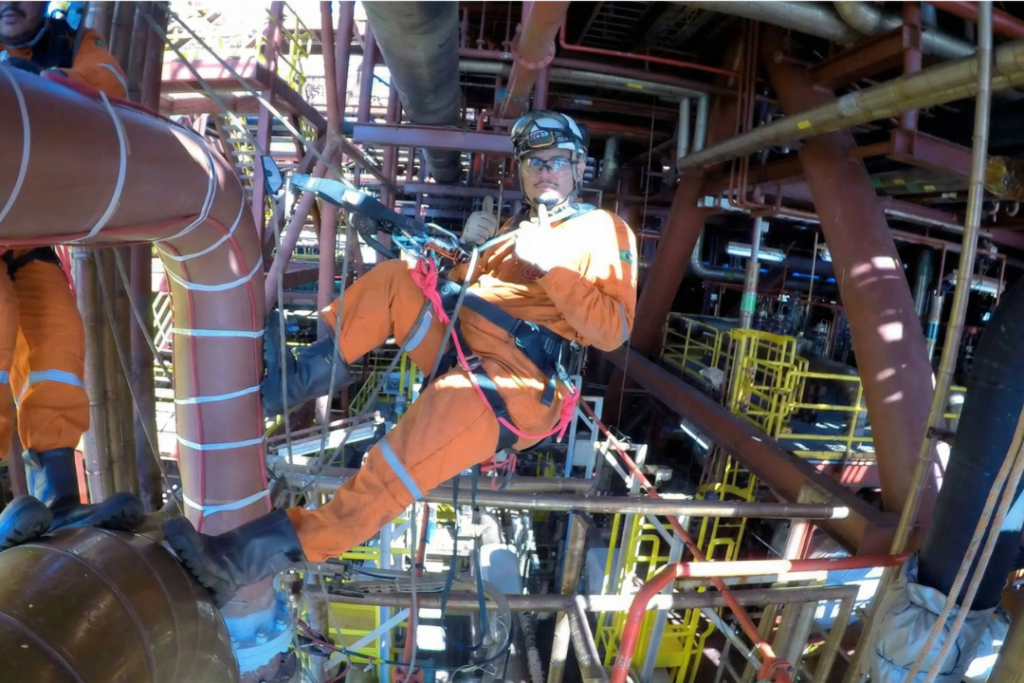
By IRATA code of practice, rope access teams have at least two people, with a Level supervisor 3 non-local present, and solo work is not allowed. These rules are the backbone of a certification scheme with three progressive levels, recognized worldwide. Understanding what each level means helps hirers know exactly who will move up in their plant., and with what responsibility.
IN IRATA (Industrial Rope Access Trade Association) is the international association that establishes safety and competency standards for rope access professionals in industrial environments. Founded in 1987, is recognized globally as a reference in training and certification in this type of work at height.
No brazil, working at height is regulated by NR35, which establishes minimum protection requirements for activities carried out above two meters with a risk of falling. As we have already shown on this blog, IRATA certified professionals meet and exceed NR35 requirements, which makes certification a relevant differentiator in industrial projects involving tanks, elevated pipes and difficult-to-access structures.
What not every contractor knows is the internal structure of this certification: three progressive levels, each with skills, responsibilities and own requirements.
How progression works
The IRATA scheme is built on proven experience. Each technician maintains a logbook, the official record of your rope access working hours, signed by a Level supervisor 3. To level up, It's not enough to take a course: it is necessary to prove, no minimum, 1.000 recorded hours and 12 months of experience at current level, in addition to being approved in an independent evaluation. And the certification is not lifetime: okay for 3 years, with mandatory reevaluation for renewal.
LEVEL 1
The technician in training
The Level 1 is the gateway to the system. This technician is capable of performing a defined range of rope access tasks, always under the supervision of a Level 3. To get here, No prior rope experience required: requirements are physical and medical fitness, minimum age of 18 years and passing training and independent assessment.
In practice, the Level 1 is a professional trained and evaluated by international standards, operating within a system that ensures it never works without qualified supervision.
LEVEL 2
The experienced technician
The Level 2 is the technician who has already proven experience: no minimum 1.000 recorded hours and 12 months as Level 1. Therefore, your skills expand: he is able to assemble the working ropes (the so-called rigging), perform rescues and perform a wider variety of tasks, knowledgeable about legislation, rope access safety requirements and quality procedures.
Even so, one rule remains: the Level 2 also works under the supervision of a Level 3. Autonomy grows with the level, but qualified supervision never leaves the scene.
LEVEL 3
The security supervisor
The Level 3 is the top of the system, and the role changes its nature: in addition to mastering the most advanced techniques, he is responsible for the safety of the operation. It's the Level 3 who supervises the workplace, conducts hazard identification and risk analysis, and organizes and executes rescue plans appropriate to each work front.
To get there, the path repeats itself: minimum of 1.000 hours and 12 months of experience as a Level 2, plus passing the independent assessment of the most demanding level of the scheme.
Rules that apply to the entire team
- Two requirements of the IRATA code of practice summarize the system's philosophy: Rope access teams must have a minimum of two people, one of which must be a security supervisor Level 3 non-local present, and solo work is prohibited. There is no IRATA operation without qualified supervision in the field.
Besides that, Technicians who spend more than six months without working in rope access need to undergo refresher training before returning to work, a guarantee that on-field skill is always up to date.
What does this mean for hirers
For the contractor, IRATA levels function as a map of responsibilities for the team that will work at your plant. And they allow a simple and revealing question in the hiring process: who is the Level 3 of the team, and he will be present on site during the execution? In an operation in accordance with IRATA standards, this answer exists before the first string is anchored.
IRATA of Tayga
Tayga uses certified rope access professionals according to IRATA standards in its industrial heating and insulation projects, meeting and exceeding NR35 requirements. And it goes beyond certification: maintains its own training center, where the team practices rope access scenarios before heading to the field. Safety at height, on here, It is not an item in the contract: It's part of the method.
In summary: the three levels
The IRATA certification map
- As per the IRATA International certification scheme.
- 1. Level 1: entry technician, performs rope access tasks under the supervision of a Level 3;
- 2. Level 2: experienced technician (1.000 hours and 12 months as Level 1), assembles work ropes and performs rescues, still under supervision;
- 3. Level 3: security supervisor, responsible for the location, for risk analysis and rescue plans;
- 4. All team: minimum of two people, with a Level 3 gift; solo work prohibited;
- 5. Certification valid for 3 years, with reevaluation; recycling after 6 months of inactivity.
Have an application in mind? Talk to us.