

The cost of skipping the thermal calculation does not appear in the proposal. He arrives later, diluted in the energy bill, in unplanned stops and corrective maintenance, and that's why it's so easy to underestimate when hiring. This article shows where this cost hides and why the thermal loss calculation is the cheapest item in the entire project.
All heat trace system, electric or steam, exists for a function: replace the heat that the line loses to the environment. And this heat loss is not a kick: it depends on known variables, as the holding temperature, the external environment, the type of fluid, line length and insulation quality. Thermal calculation is the engineering work that transforms these variables into the power that the system needs to deliver, no more, no less.
When this calculation is not done, or is replaced by estimate, the project sails without instruments. And mistakes can happen both ways, each with their own account.
The cost of undersizing: the system that doesn't deliver
An undersized system provides less heat than the line loses. The result is thermal failures: the temperature does not hold, the fluid cools beyond the limit and the problems that the thermal trace existed to avoid happen anyway, loss of fluidity, difficulty pumping, stop risk.
This is the most visible cost, because it appears in the form of an interruption. An unplanned stop on a critical line leads to lost production, in team mobilization and in emergency, and correcting an undersized system after installation costs more than the calculation that would have prevented it.
The cost of oversizing: the silent account
The opposite error seems safer, and that is precisely why it deceives. An oversized system works: the line gets hot, no one calls at dawn. But it consumes unnecessary energy every day, in the form of electricity or steam beyond what the application requires.
It is a cost that does not generate alarm, does not open ticket and does not appear in failure report. It just accumulates, month after month, within the energy bill, turning a project shortcut into a permanent operational expense. As we have already shown here: in heat trace, shortcuts in the initial investment tend to become recurring costs in the operation.
The points that the calculation cannot ignore
Even when there is some sizing, there is a classic error: calculate the line as if it were just meters of straight pipe. Valves, Flanges and brackets dissipate more heat than a straight section of piping, and when these points are ignored, the system is forced to operate above the power required to compensate, Raising consumption.
The same goes for thermal insulation: it is one of the greatest allies of the system’s efficiency, and a calculation that assumes good insulation when it is deteriorated, or non-existent, starts from a false premise. The account is closed on paper and denied in the operation.
What a well-designed system returns
The good news is that the opposite is also true.. A system with correct technical dimensioning, Precise temperature control and adequate insulation reduces steam or electricity consumption, delivering exactly the power that the application demands. And the gains go beyond energy:
- Minor operating cost (OPEX): less energy, less corrective maintenance and longer equipment life;
- Thermal stability: Stable temperatures mean fewer operational adjustments and fewer process interruptions;
- Predictability: a system sized for the real application behaves as the design predicted, no surprises.
The cheapest item in the project
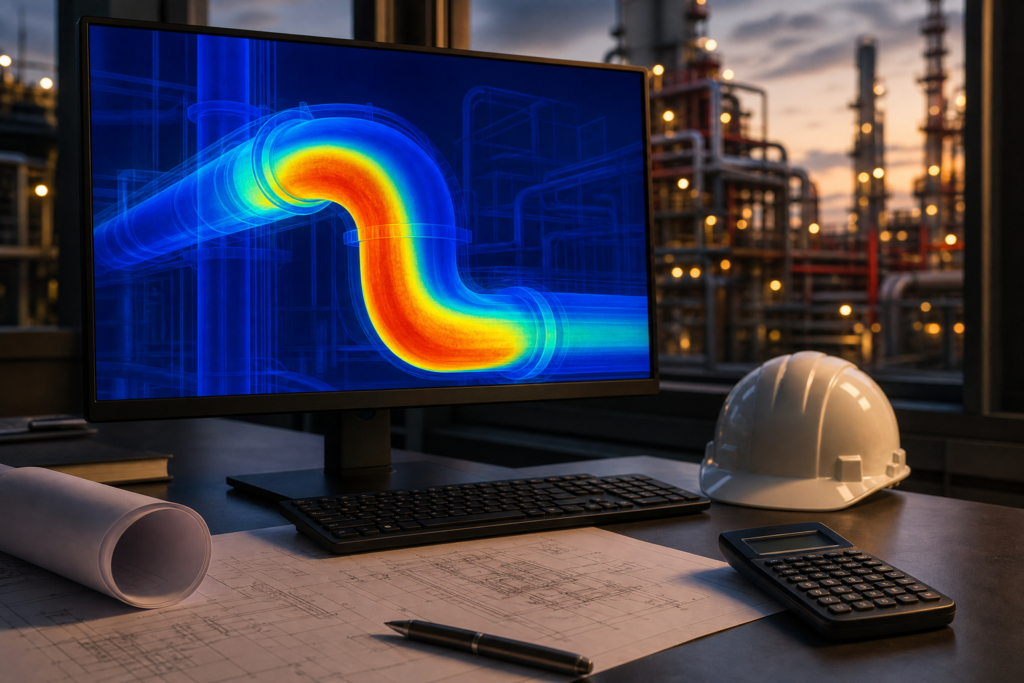
Put on the scale, the thermal calculation is disproportionate: is a fraction of the project investment and determines the behavior of everything else, do energy consumption maintenance frequency. That is why, na Tayga, projects are based on individual thermal loss calculations, with support from simulation software, considering the real variables of each application: maintenance temperature, environment, fluent, line length, accessories and insulation.
It's not an extra step in the process. It's the step that makes others count.
In summary: where the cost hides
The account of not calculating
- The four places where design without thermal calculation pays off later.
- 1. Subsizing: thermal failures, vulnerable line and risk of unplanned stoppage;
- 2. Oversizing: unnecessary energy consumption, permanent and silent;
- 3. Ignored critical points: valves, flanges and supports forcing the system above the required power;
- 4. False premises about isolation: a calculation that closes on paper and belies the operation.
Have an application in mind? Talk to us.