

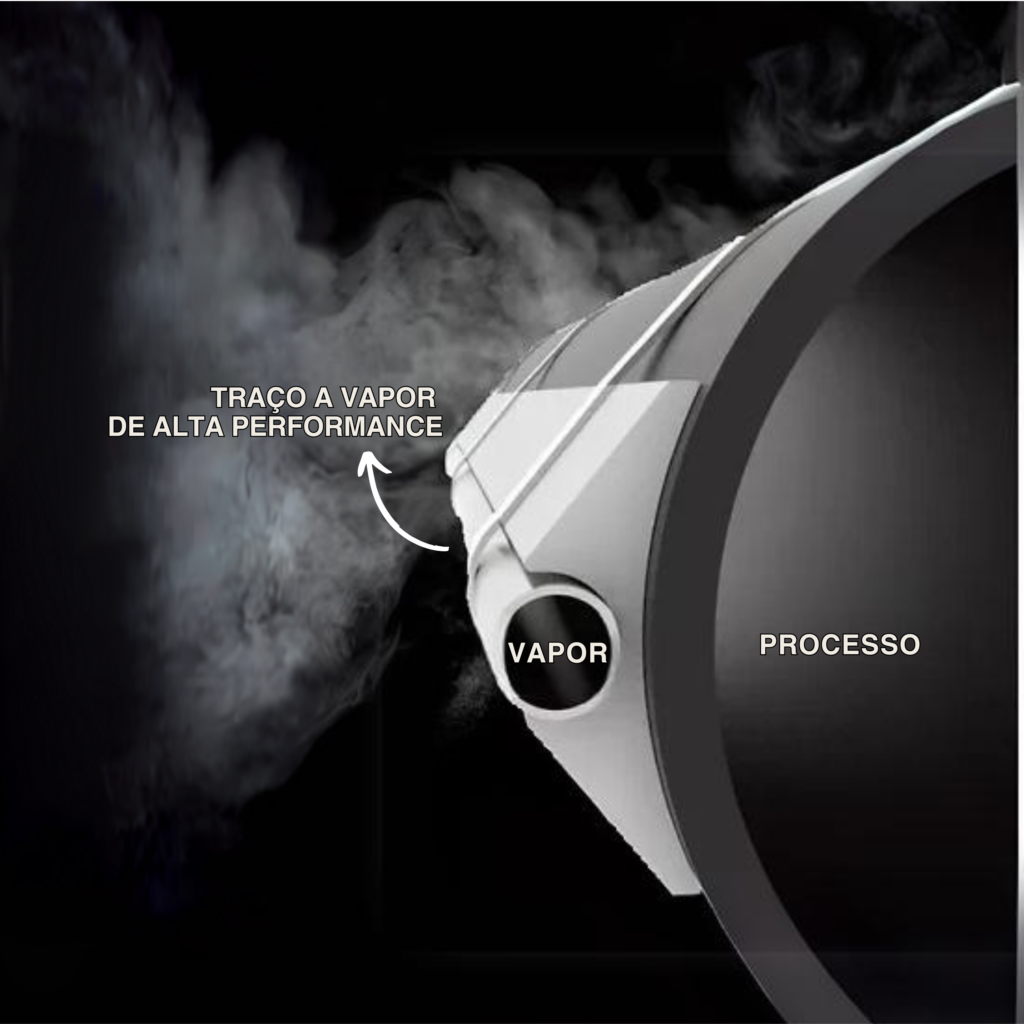
The morning gets cold, the product thickens inside the pipe and, the next morning, the pump doesn't work. The line for, production awaits. Scenes like this are repeated in plants that move heavy oils, resins, sulfur and other temperature-sensitive fluids. The steam dash exists to avoid them, and a good project starts with the right questions. Here are the ten things Tayga does before making any proposal.
Steam tracing is a system used to maintain the temperature of a pipeline, equipment or process line, using steam as a heat source. In practice, a smaller pipe, the tracer tube, accompanies the main piping. Steam passes through this tracer and transfers heat to the process line, compensating thermal loss for the environment.
Many industrial products need to remain within a certain temperature range to continue flowing properly.: heavy oils, greases, resins, sulfur, chemicals, syrups, fuels and caustic soda are examples of fluids that thicken, crystallize or solidify when cool. When this happens, the consequences cascade: loss of production, line clogging, difficulty pumping, unplanned stops, loss of product quality and even operational risks.
But each steam trace application is unique. The product, the temperature, the line, the plant environment and infrastructure completely change the solution. That is why, before any proposal, Tayga's analysis seeks to answer ten questions.
They define whether steam tracing makes sense for your case and what the solution path is..
QUESTION 1
Which product passes through the line?
It all starts with the process fluid. It freezes, crystallizes, hardens or becomes viscous when cooled? It's flammable, corrosive, toxic or heat sensitive? These answers matter because not every product can receive heat in the same way. Some only need light thermal maintenance; others require careful control so as not to degrade or lose quality.
QUESTION 2
What temperature needs to be maintained?
In addition to the minimum temperature that the product needs to maintain to continue flowing, There is other equally important information: there is a maximum temperature that cannot be exceeded? Defining this operating range is what guides the entire solution, from the number of tracers to temperature control.
QUESTION 3
What happens if the line gets cold?
This question measures the size of the risk. For some operations, a cold line just means an inconvenience; for others, means clogged pipe, forced pump, production stoppage and lost product. Understanding the consequence helps to define the criticality of the system and the level of robustness that the project needs to have.
QUESTION 4
What is the diameter and length of the pipe?
Thermal logic is straightforward: the larger the diameter and length of the line, the greater the area losing heat to the environment, and the greater the energy required to compensate. The route of the line also counts, with your curves, valves, flanges, instruments, pumps and drainage points, who cannot be left out of the survey.
QUESTION 5
The line is thermally insulated?
Which isolation, the steam dash loses a lot of efficiency. It's like trying to keep a drink hot in an open mug, exposed to the wind: you will need to provide much more heat all the time. Therefore, the analysis checks whether the line already has insulation, what kind, how thick, under what conditions and with what external protection. Bad insulation, damaged or non-existent can make the solution more expensive, increase vapor consumption and compromise performance.
QUESTION 6
The line is indoors or outdoors?
A line exposed to time, in the wind, in rain or low ambient temperature it loses more heat. So much so that two lines with the same product may need different solutions just because they are in different environments. The installation location is part of the project, not a detail.
QUESTION 7
What vapor is available in the plant?
Steam dash depends on existing infrastructure. There is a steam network nearby? What is the available pressure? The steam is saturated or superheated? There is a power point? The answer defines the viability and design of the solution, from power points to collectors.
QUESTION 8
There is condensate return?
When steam delivers heat, it condenses. To be condensed needs to be drained correctly through traps and, when possible, returned to the system. A steam trace project that does not treat condensate is incomplete, and this is one of the checks that most differentiate a well-done analysis.
QUESTION 9
There are drawings, isometrics or photos of the installation?
Technical documentation speeds up analysis and reduces the risk of error. Isometrics, designs, photos of the line and accesses allow the technical team to see the application before the visit and arrive in the field with the right hypotheses.
QUESTION 10
You need to maintain the temperature or heat the product?
- This distinction changes everything. “I need to keep this line 80 degrees” is thermal maintenance, the natural territory of the steam dash. “I need to elevate the product 25 for 80 degrees in two hours” It's a need to warm up, which typically requires more detailed thermal analysis: heating time, product mass, thermal capacity, flow, operating regime and required power. Confirming which of the two is your case avoids wrong proposals from both sides.
In summary: as 10 questions
Tayga analysis script
- Answers that guide feasibility and solution.
- 1. Which product passes through the line?
- 2. What temperature needs to be maintained?
- 3. What happens if the line gets cold?
- 4. What is the diameter and length of the pipe?
- 5. The line is thermally insulated?
- 6. The line is indoors or outdoors?
- 7. What vapor is available in the plant?
- 8. There is condensate return?
- 9. There are drawings, isometrics or photos of the installation?
- 10. The objective is to maintain temperature or heat the product?
From answers to solution
With these ten answers in hand, Tayga conducts the analysis in four movements: understands the real need, raises the minimum application data, evaluates preliminary technical feasibility and directs the case for proposal, technical visit or engineering analysis, depending on the complexity. Simple applications quickly advance to a preliminary solution. Critical applications, with dangerous products, high temperatures, large expanses or strict control, involve engineering from the beginning.
Have an application in mind? Talk to us.